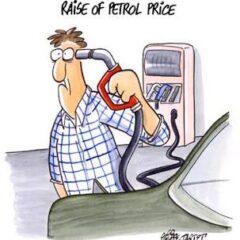
It’s the time again! Petrol and Sugar price increased again! So other thing will follow to shoot up the price except our salary, how to survive like that?? =(
The price of sugar will go up 25sen to RM1.75 per kg; LPG will go up 10sen to RM1.85 per kg; petrol RON95 will be up 5sen to RM1.85 per litre and diesel will be up 5sen to RM1.75 per litre.
RON 97 will no longer be subsidised. It will be subjected to a managed float, where the price will be determined by the automatic pricing mechanism. The question is, petrol price increase other price follow but when the petrol price decrease or reduce, the other price will not go down and it will not float but only up! That’s the worst case!
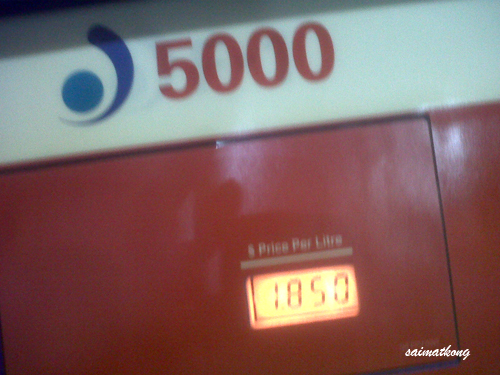
I just went to pump and it’s RM1.85 now! =( but luckily only 5sen but it’s still my hard earn money!
Before Fuel Price Increased : 33.31 Liter for RM60
After Fuel Price Increased : 32.43 Liter for RM60
So in conclusion, each RM60 pump will rugi 0.88 liter, if pump full tank will rugi 1.2 liter which will translate to 1.2 * RM1.85, so each full tank I gonna pay more RM2.22
Before if you pump RM80 which will translate to 44.444 liters
Now if you pump RM80 which will translate to 43.243 liters
So you will only rugi 1.2 liters which will translate to RM2.22! Wow. How much will you rugi? So I cannot have my nasi lemak + teh tarik for breakfast anymore… =(
Prices of sugar, petrol, LPG, diesel to go up Friday
Subsidy removed for RON 97 petrol
KUALA LUMPUR: From Friday, the subsidies for sugar, petrol, liquefied petroleum gas and diesel will be cut as part of the gradual subsidy rationalisation programme, according to a statement from the Prime Minister’s office on Thursday.
The price of sugar will go up 25sen to RM1.75 per kg; LPG will go up 10sen to RM1.85 per kg; petrol RON95 will be up 5sen to RM1.85 per litre and diesel will be up 5sen to RM1.75 per litre.
RON 97 will no longer be subsidised. It will be subjected to a managed float, where the price will be determined by the automatic pricing mechanism, the statement said.
The details of these changes are now available on the PMO and PEMANDU websites, at: www.pmo.gov.my and www.pemandu.gov.my.
On May 27, Minister in the Prime Minister’s Department Datuk Seri Idris Jala had said that Malaysia would be bankrupt by 2019 if it did not cut subsidies and rein in borrowings.
He had said that Malaysia’s debt would rise to 100% of GDP by 2019 from the current 54% if it did not cut subsidies.
Meanwhile, In ALOR SETAR, Prime Minister Datuk Seri Najib Tun Razak said that when implementing the subsidy rationalisation plan, the Government would seek not to burden the people.
He said the rationalisation move was necessary to reduce Government expenditure and strengthen the financial position of the country.
“It will help reduce the fiscal deficit so that world and local markets will have more confidence in the national economy,” he told newsmen after opening the Kuala Kedah Umno division meeting here on Thursday.
He added that the Government was reviewing all types of subsidies.
The full press statement from the Prime Minister’s office is below:
1. To help Malaysia maintain the strong growth it has achieved, the Government has implemented difficult but long-needed economic reforms that will help Malaysia become a developed and high-income nation. In this regard, the Government has begun a planned and fair reform of a subsidy regime that for too long has been ineffective in helping those who need it most and, over time, has become a barrier to Malaysia’s progress.
2. The Government has made bold economic decisions over the past two years. Two stimulus packages were introduced, promoting growth, even as the global financial crisis spread. Important sectors of our economy further liberalised were opened to new investment.
The Government cut spending by RM24 billion, by reducing waste and inefficiency. As a result, the country’s economy has been reinvigorated, with 10.1% growth in the first quarter of 2010, Malaysia’s best performance in a decade. Although there is still instability in the global economy, Malaysia is well positioned for the future – not by chance, but by the choices we have made together.
3. As set out by the Prime Minister when he announced the 10th Malaysia Plan, Malaysia’s national goals cannot be achieved by simply managing through a crisis. Malaysia’s ambition is to be a high-income nation, with opportunity for all.
4. In the New Economic Model, the Prime Minister set out plans for further investment in key strategic sectors, upgrading our infrastructure, creating additional private sector investment opportunities and realizing higher levels of GDP growth.
However, growth alone will not allow us to meet our goals. As the Government has consistently said over recent months, we must also implement subsidy reforms that will remove distortions in the marketplace and enable us to better target our resources on those most in need, and on investments that will provide lasting benefits for Malaysians.
5. With these priorities in mind, the Cabinet has decided that, effective 16 July 2010, subsidies for fuel, specifically petrol, diesel and liquefied petroleum gas (LPG), as well as sugar, will be reduced as the first step of a gradual subsidy rationalisation programme.
Subsidies for RON 95 and diesel will be reduced by 5 sen per liter. LPG will be reduced by 10 sen per kilogram. RON 97 will no longer be subsidised. It will be subjected to a managed float, where the price will be determined by the automatic pricing mechanism. For sugar, the upward price adjustment will be 25 sen per kilogram. The details of these changes are now available on the PMO and PEMANDU websites, at: www.pmo.gov.my and www.pemandu.gov.my
6. These minimal changes will help Malaysia achieve a position of fiscal responsibility and put us on a path toward reducing our deficit. To meet these objectives, we have chosen to make adjustments to our subsidies. Even after these changes, the Government will still spend an estimated RM 7.82 billion on fuel and sugar subsidies in 2010. The prices of fuel and sugar in Malaysia will still be among the lowest in the region.
7. This subsidy rationalisation will, according to estimates, allow Malaysia to reduce Government expenditure by more than RM 750 million in 2010.
8. The decision to reduce subsidies for fuel and sugar is based on the fact that reducing fuel subsidies will have the greatest impact on government spending and reducing sugar subsidies will allow us to promote healthier lifestyles. The decision is also grounded on three main concerns:
a. First, these subsidies also benefit foreigners and wealthier Malaysians, who can well afford to pay unsubsidised prices. Our focus should be on helping the family sharing a motorcycle or Kancil to get to work and school, but instead our spending on subsidies has provided the same benefits to those driving imported luxury cars.
The sugar subsidy disproportionately benefits industries, not families. Businesses have been using almost twice as much subsidised sugar as Malaysian households.
b. Second, highly subsidised prices often lead to illegal smuggling of these goods. Because subsidies make these products the cheapest in the region, in 2009 alone smugglers were caught heading out of Malaysia with more than 200 metric tonnes of sugar to be sold across borders.
Also, subsidised diesel continues to go to the black market or across our borders, instead of to those we meant to assist. Law enforcement have been doing their best to prevent smuggling, with 109 sugar related arrests last year. This is the tip of the iceberg. As long as there are big price differences, smuggling will continue. And:
c. Third, unless we reduce our consumption of fuel and sugar, we face potentially serious consequences as a nation. We are quickly depleting our domestic fuel resources. It is vital that we rationalise our fuel use – as well as develop new energy technologies – as a matter of economic, energy and national security.
In this regard, we have implemented a number of policies to protect the environment. We must also reduce our sugar consumption. 40 percent of Malaysians are now either overweight or obese.
Incidents of diabetes are rising quickly. Statistics show that the percentage of Malaysians with diabetes now exceeds that in the United States. We must, as a matter of urgency, take every step available to tackle what is clearly a public health issue for our nation. Reducing sugar consumption, among our children in particular, is a step in the right direction.
9. These are among the reasons why the Government has chosen to focus on sugar and fuel subsidies. Subsidies for education and health care will continue. These are areas of importance for our economy and our society where the Government should be investing.
These include, providing support to develop skills, training the knowledge based workforce of the future and improving the well-being of the nation.
10. The Government arrived at this decision following robust consultations with the people. Thousands of Malaysians participated in the policy labs, Open Day and an unprecedented public feedback process.
As with subsidy reform, the budget, the Government Transformation Program and now the National Key Economic Areas, the Government has made a determined effort to engage the public, listen and learn, and then act in the best interest of the nation.
11. These measures are designed to have a minimal impact on individual families, but long-term benefits for the nation. The reduction in expenditure from these reforms will allow us to better use resources for families, communities and business growth.
Measures such as the 1Malaysia clinics, the 1Malaysia mobile clinics, as well as the scholarships for all 9A+ and deserving students, specifically those who have done well, but come from lower income families, are made possible by such reforms.
Similarly, by reducing expenditure on subsidies we will be able to continue strengthening such initiatives as the price standardisation project, which seeks to harmonise prices of essential goods between urban and rural areas in Sabah and Sarawak.
12. The Government has made a difficult, but bold decision. By choosing to implement these modest subsidy reforms, we have taken a crucial step in the right direction towards meeting our commitment to reduce the fiscal deficit, without overburdening the Malaysian people.
These measures are a demonstration of our fiscal responsibility. They will enhance Malaysia’s financial stability, while also protecting the Rakyat.
PUTRAJAYA: Malaysians may be paying less for fuel soon as the Cabinet is mulling over the possibility of lowering the present prices.
Several Cabinet Ministers said the matter was discussed during their weekly meeting Wednesday but declined to elaborate, saying that Prime Minister Datuk Seri Abdullah Ahmad Badawi was expected to make an announcement soon.
Higher Education Minister Datuk Seri Mohd Khaled Nordin said the possibility of consumers paying lesser for fuel was raised and that the mechanics were still being worked out.
Information Minister Datuk Shabery Cheek also admitted that the Cabinet was studying the matter.
“Let the Prime Minister make the announcement,” he said yesterday.
Domestic Trade and Consumer Affairs Minister Datuk Shahrir Samad , however, declined to comment on the subject, saying that it would be best to wait for the PM.
The government, had on June 4, raised the prices of petrol and diesel, on grounds that that it could no longer continue to subsidise fuel, but give a 30 sen per litre discount from market prices.
Currently, Malaysians are paying RM2.70 per litre at the pump while diesel is priced at RM2.58 per litre.
PUTRAJAYA: Malaysians may pay less for fuel soon, as the Cabinet is mulling over the possibility of lowering the pump prices.
Several Cabinet Ministers disclosed that the matter was studied during their weekly meeting yesterday but declined to elaborate, saying that Prime Minister Datuk Seri Abdullah Ahmad Badawi was expected to make an announcement soon.
Higher Education Minister Datuk Seri Mohd Khaled Nordin said the possibility of consumers paying less for fuel was discussed and that the mechanics were being worked out.
Information Minister Datuk Shabery Cheek said the matter was studied by the Cabinet, but declined to elaborate.
Domestic Trade and Consumer Affairs Minister Datuk Shahrir Samad, when contacted, declined comment, saying that it would be best to wait for Abdullah to make an announcement at an appropriate time.
On June 4, the Government raised petrol and diesel prices, stating that it could no longer continue to subsidise fuel prices at the then rate. However, it would continue to provide a 30 sen per litre discount on the market price.
Currently, motorists pay RM2.70 a litre for petrol and RM2.58 a litre for diesel at the pump.
Shahrir was quoted by Bloomberg.com on Tuesday as saying that the Government might reduce fuel prices if crude oil prices stay at US$125 (RM408) per barrel for at least three weeks.
Shahrir said that it that was the case then a reduction in prices could come within the year to enable the Government to keep its pledge of maintaining a 30 sen per litre subsidy.
“Why not, it would be good news, right?” he said during the interview.
There’s news to reduce fuel prices?! Remember last two week Pak Lah supposed to announce steps to ease fuel price rise burden? But after the news, there’s no one talking about it or no updates at all? What happened? I was waiting for the steps to ease fuel price but nothing happened. Now news review that fuel prices will be lower down? How much? How soon? Is it 100% real?
I will start dreaming from today on wards for lower fuel price and better economy =)
Wait for the announcement! Hopefully yes but what about those ppl that claim their fuel subsidy of RM625 from pos office? Too bad, my road tax due at March, so I still haven’t claim back my subsidy!
If it’s really true that our fuel price will be lower down, then will other goods, food, transport all reduce their price too? I don’t think so. Roti Canai, Bread, Rice, all increased. They will happily earn more!
Isn’t this ridiculous? Few weeks back they increase Petrol Price to 2.70 a liter, now they are telling Malaysian Petrol Station only accept Cash but not credit card? It will be a lot burden to the public and trouble cause? I myself use Credit Card to pump petrol because of convenience and want to collect points for the use of Credit Card but now,
Petroleum Dealers Association of Malaysia, had sent out a notice to 3,200 members nationwide advising them to refuse all cards.
So when we need to pump RM100 ++ petrol we have to bring enough cash and if not we have to go thru all the trouble to look for ATM, withdraw money and endanger ourselves after we withdraw the money from the robber? What about after 12am and most of the ATM close? We have to wait till tomorrow? That’s s*ck!
Why is this happening? So many bad things happened to Malaysia? Malaysia Boleh?
Credit card refusal draws ire
GEORGE TOWN: Motorists here are fuming over the sudden move by petrol stations here as well as Kedah and Perlis to refuse payment by credit and fleet cards.
The decision was made following a meeting in Butterworth at 3.30pm yesterday to discuss a circular by the Petroleum Dealers Association of Malaysia, which had sent out a notice to 3,200 members nationwide advising them to refuse all cards.
More than 400 stations in the northern region decided to enforce the move and started refusing the payment from midnight.
In the meeting, Mobil Stations Malaysia deputy president Roslan Jamaludin said petrol station operators could no longer shoulder the burden of the card charges.
“We lose nearly 50% of our profit to card transactions. How are we going to cut costs if everyone uses cards for their purchase?” he asked.
He added that operators agreed to this “business decision” for “long-term survival” and to highlight their plight to the Government.
Motorist Zafran Zakri Mohamad, 37, said the petrol station operators should not be heartless.
“We are struggling to cope with the recent increase in fuel price. We thought we could depend on credit cards when we run out of cash.
“But now we cannot not even use credit cards. And to impose such a ruling at a time of month when most people are running out of cash is really unacceptable,” said an irate Zafran.
Car rental agent Kintan Natasuri Aziz, 40, who uses the fleet card, said the new ruling would pose much inconvenience to him, as he has to travel outstation to send and pick up cars for rental.
“We also do not carry much cash,” he said.
Another motorist, Maisarah Khairul Anuar, 27, said that if petrol station operators were unhappy with the interest imposed by the banks then they should take it up with banks.
“They should not make consumers suffer,” she said.
Ryan Tang, 31, a graphic designer, said it was not right to immediately implement such decision without giving prior notice to customers.
“What if we run out of petrol after midnight when the ATMs are closed and we cannot withdraw money?” said Tang.
GEORGE TOWN: Motorists throughout the country were left fuming and confused on Tuesday, all because of the push by petrol station owners to ensure that their profit margins are maintained.
> 400 petrol stations in the northern region decided to stop accepting payments by credit card by today,
> Motorists are angry that they have to pay by cash, especially when they are now paying more for their fuel,
> Chaos broke out in several towns in Sabah and Sarawak as panicked vehicle owners rushed to petrol stations to fill up after receiving irresponsible SMSes that petrol stations were closing for three days,
> Vehicle owners in the peninsula were also worried after receiving similar untrue SMSes of petrol stations closing. source : TheStar
vox populi big thumbnail‘It will put both businessmen and politicians in their place. For too long, both of them have been shortchanging the Malaysian public.’
Joe Fernandez: All this is a blessing in disguise. Look for the silver lining in the cloud and count your blessings. Be thankful and grateful and you will have even more reasons to be thankful and grateful for.
I am glad the runaway fuel prices will put Malaysian businessmen, noted crooks and criminals, in their place. Traditionally, they shortchange their workers, the consumers, the government and investors. Now, they are forced to absorb the rising fuel prices and make do with smaller profit margins. If they increase prices for their goods and services, the market will eliminate them.
The runaway fuel prices will also put the politicians in their place. In the past, they were in cahoots with their businessmen friends to create unnecessary government projects to steal indirectly from the treasury.
Dr S Vijayaratnam: In view of the increased cost of fuel, particularly diesel, the government is urged to give priority to the commercial transport sector. The uninterrupted operation of haulage of goods, especially food items, is essential to the well-being of the general public.
We don’t want to see a situation where, due to a slow-down or cessation of this lifeline, wet markets, supermarkets and hypermarkets are devoid of meat, vegetables and grain on their shelves. Such a scenario is frightening, and can lead to social problems and unrest. We can see it building up in Spain and Thailand right now.
It was pointed out in a recent newspaper article that if the food supply chain is hampered for just three or four days, and retail outlets are empty, there is the danger of people becoming desperate, and no telling what they could resort to.
We appreciate that lorry transporters recognise their national responsibility, and are continuing with their operations. However, it is vital that compensation or incentives in some form is given to them, so that daily groceries and edibles from farms, abattoirs, ports and warehouses, most of which are perishable, continue to be delivered.
Among other measures, road tax reduction, exemption of import duties on spare parts and tyres and raising the fleet-card quota for subsidised diesel could be considered.
If we are talking about food security, transportation an essential component. The process cannot be compromised due to high fuel costs. (the writer is vice-president, Gerakan).
JD Lovrenciear: In the wake of the pandemonium resulting from the horrendous fuel price hike, the government recently announced several cost cutting options involving ministers.
Unfortunately the government’s seemingly good intentions has only drawn much flak from the public. Perhaps the government should consider some common sense back-to-basics strategies to gain brownie points and also to address the fuel-price threats effectively.
As any crisis also offers opportunities, the government should think outside the box and table more pragmatic solutions. One such creative solution would be bringing back the humble trishaw to our streets.
Numerous streets in the towns and cities could be turned into trishaw-thoroughfares without much complication.
Bringing the trishaws back also serves as a double bonus. Not only will the demand for fuel be reduced and the street air made more breathable, it also offers many Malaysians an opportunity to earn or save that extra ringgit to help combat the financial squeeze.
Further, if properly nurtured – minus the greedy grabbing hands of politician-businessmen, many of our young and enterprising youths could be well on their way to earning a decent income let alone being more productive.
Surely the rakyat will find the trishaw rides convenient, cost-effective and above all, save the nation’s fuel burning arising from unending traffic jams in main cities and towns.
Hopefully if the government does not take this idea through, the opposition government in the several states could take up the suggestion and show our ruling government the ‘way forward’.
Albert Heng: I don’t believe that ministers ever pay for any entertainment so why should they get an allowance for it at all? In all cases, I believe certain people would rush to pay for any entertainment for a minister, or perhaps be cowed into paying!
Mooshie Mooshie: Will Petronas show us its accounts? No way, not in a million years. It is also known as the ATM (automated teller machine) of the Malaysian government namely Umno’s giant cash kitty.
It will get a lot of people in trouble if Petronas has to show its accounts to the public or parliament. Maybe when the Pakatan government comes to power, then it can be done.
So fellow Malaysians you know what to do lah. And to Pakatan you also keep your promise ya?
Joe: The foreigners are merrily chirping away again, ‘Cheep! Cheep!’ And why not? At RM 2.70, they’re paying about half of what they pay at home!
Why raise the petrol price for locals so heftily and allow the foreigners to enjoy the same ‘cheep’ price? Simple arithmetic will tell you to raise the price for foreigners to a level high enough to offset whatever claimed losses Petronas is suffering but still lower than foreign prices – RM4.50 for example. They will still pay as they still save.
Arthur Chan: Many Malaysians are not aware that the state of Kelantan has not been explored for oil and gas. The BN government didn’t spend any money on this state because it is under PAS rule. The sea area off Kelantan state is just as large as Terenggnau’s.
John Johnson: I am a bit surprised that the royalty are keeping mum over the dissatisfaction of the majority of the rakyat. There are important issues that are causing pain and suffering to the rakyat but not one of them has come out openly to say something to let the people know that they are supportive of the rakyat.
Richard Kamalanathan: The oil price has been rising remarkably in the last six months beyond our meagre expectations and it is not going to recede as much as we would wish it to be. It is has increased our burden of movement via private and public transportation;
The government may not be able to interfere as much as it would wish to. The international and global economy has to confront these rises and adapt its future course in accordance with numerous rises in other sources of energy especially electricity.
The price of steam coal has risen by leaps and bounds now too. The cost of electricity has yet to rise. I do not wish to appear fair to the government but I only wish that most of us would approach our own political parties to which we belong to come out with a clear policy as to how we can overcome the oil prices and help the people who are in dire need of survival.
The survival syndrome in Malaysia is already around the corner and political parties like the DAP, PKR and PAS must explain how they will overcome these increases and promise the people who have elected them a better alternative.
Ikunosan: The government should retract all APs issued, and instead sell the APs to anyone that wants to import a vehicle. This way, the estimated 7000 – 10,000 APs issued a year can generate, at RM40K average price of an AP, an estimated: RM 40,000 x 10,000 AP = RM400,000,000!
This is all about BN mis-management, they giving out APs to help only the few.
Hafiz: Personally, I have no qualms on the right of the people to voice their dissatisfaction on the increase in fuel prices. My view is that such protests should be channeled through proper means.
I personally feel that the organisers should think twice about organising another ‘mega’ protest because it can lead to a waste of resources especially if such an action is planned to be repeated.
Protests on the street can lead to road closures, traffic congestion and a sudden influx of people coming into the city – aren’t these leading to a waste in fuel for the ordinary Joe who is stuck in his car trying to get home but ‘forced’ to join in the rally of people?
Can we think of other means of protests instead of street rallies, please?
Maniam Sankar: Okay, so improvements to public transport will only feature in Budget 2009 says the finance minister. When the last price increase for petrol was announced , there was a promise to improve public transport including adding more coaches to train.
Even a date, October 2008, was mentioned for the additional coaches. And now the minister only wants to include it in the 2009 budget which means we’ll be lucky to see the expansion in early 2009, if at all. In the meantime, dear Malaysians, do be resigned to the ‘sardine tin’ rides
Allow me to suggest immediate improvements to the bus service so that they follow the example of buses in Singapore and most Australian cities. During peak hours (6.30aam to 9am and 4.30pm to 7pm say ) send express buses direct to the residential areas.
Do not let them go from one taman to the next before going to the city or vice versa as that lengthens the commute time. For example, instead of sending buses at 10 minute intervals and going through two or three taman, send one direct bus every 20 minutes from each taman.
After peak hours, stop buses, except those from neighbouring suburbs from coming into the city but use them to ferry commuters to the nearest train station and shopping areas. By this time, the crowd will be latecomers and moms will be doing shopping so this will fill up trains and buses which will be running empty by now.
This system works in the cities aforementioned. Right now, not many bus routes pass the nearest shopping centres or train stations as they are all headed to KL only. There is hardly any intra- taman or neighbourhood bus services.
It is presently easier to get from any suburb to KL than from, say , PJ to PJ or Subang to Suban. Please do the easy fixes first. The grand solution can come later.
John Lee: I think Dr Dzulkefly has made a mistake in his economic analysis of subsidies. As a general rule, subsidies and indirect taxes are part of the field of micro-economics. A simple microeconomic analysis would actually suggest that subsidies are harmful because they isolate people from the costs of their actions – there is a ‘deadweight loss’, to use some economics jargon.
Of course, the situation is more complicated than that, but ultimately I don’t think subsidies are the best way to aid the poor.
A proper macroeconomic analysis of the situation would treat the subsidies as government spending. As a rule, government spending does boost the economy. Dzulkefly is correct to say that this is ‘beneficial for the rakyat.
However, not all spending is alike. A subsidy primarily benefits people who buy a lot of petrol. Those who buy gas guzzlers and drive over the speed limit benefit more from the subsidies than those who take public transport or drive compact cars. This government injection of money into the economy primarily benefits the rich.
A more appropriate form of spending would be to give people the money directly, perhaps in accordance with their income (so a middle-class family gets a smaller or even no rebate, while the hardcore poor get substantially more).
This would be more efficient than an un-targeted subsidy, and would act as a subsidy for whatever the families decide to spend their money on, rather than just a subsidy for petrol. If I decide I would rather buy a book than fill up my tank, I still benefit.
Unfortunately, the government persists in ill-advised fiscal policies. Petronas’ profits should not be going to prop up foundering cronies’ enterprises or subsidising ministers’ vacations. They should be rebated directly to the Malaysian people, or invested for long-term benefit of the country.
The government’s reduction of the fuel subsidies is a good start, but as long as they spend the new revenues imprudently, our frustration at the government will continue to be justified.
Stephen Chew: In the article, the writer touts the ability of net oil-exporting countries like Venezuela and Iran, to provide highly subsidised fuel for their citizens, implying that surely Malaysia can and should do the same.
Beware the paradise of cheap petrol, as the real picture is not as rosy as depicted. The truth is that the governments of Venezuela and Iran have been trying for years to remove these economically distorting subsidies, but are cowed by vociferous citizens who treat cheap oil as a birthright.
Ever since 1989, when thousands of Venezuelans died in fuel hike protests, reducing fuel subsidies have become politically impossible even for the popular President Chavez (he calls the subsidy ‘disgusting’).
Despite ever rising oil prices, the Venezuelan economy does not benefit as huge amounts of money are drained from the national oil company to pay for subsidies – money that could instead be used for social welfare and development programs. Sounds familiar?
You might think it would be easy to fill up your petrol tank in a country that exports more oil than almost any other country in the world. But as of May 21, 2007, Iranians are no longer free to buy as much subsidised petrol as they want due to a rationing system introduced by the government in Tehran – resulting in riots which destroyed many petrol stations.
Until then, the government of Iran had subsidised gasoline to keep prices down, but the programme has proven exorbitantly expensive in a period when the Iranian economy is struggling.
Can the Iranians really afford to provide cheap petrol for its citizens as the writer asserts?
What is clear is that oil prices in Venezuela and Iran have been kept low despite its devastating economic consequences! Do we really want Malaysia to follow in their footsteps?
Soo Ching Pin: Concerned Netizen mentioned that an air-conditioner is in use in the house he/she was talking about. I think that is the culprit for power consumption. My younger brothers have installed air-conditioning in the house that they share with my mother.
Since they did that, their monthly electricity consumption has gone over 200 kW, just as in Concerned Netizen’s house.
On the other hand, I do not have air-conditioning in the rented house where I live. I live alone and my monthly electricity consumption has averaged less than 100 kW so far. Granted, I am not at home at least 10 hours a day as I work outside the home, except for my off days.
But when I am at home, I will usually have at least one light on. I also have the standard household appliances like a refrigerator, TV set, DVD player, a rice cooker, a kettle, etc. Of course, the refrigerator is always on unless I shut it down for defrosting but that will only take an hour or so every two weeks or more.
So I conclude that when the government says that more than half the households in Malaysia use less than 200 kW per month, those are the households that do not have air-conditioning. Can we have some statistics from air-conditioning suppliers as to what percentage of Malaysian households have installed air-conditioning?
Then we can see whether their figures are consistent with what we would expect in view of the government’s figures on the proportion of Malaysian households using less than 200 kW per month.
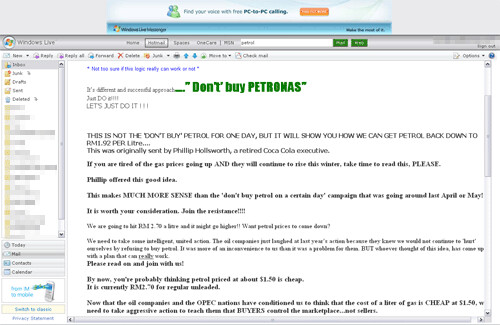
Did you receive chain email letter asking you to boycott Petronas so that they will reduce the fule/petrol price? I myself receive a lot in my different-different mail box but I do not forward it and don’t think it will work and it will only affect the economy? The email title “Let’s get those fuel prices down”… If you receive it do not forward!
here’s the content of the email:
* Not too sure if this logic really can work or not *
It’s different and successful approach….” Don’t’ buy PETRONAS”
Just DO it!!!!
LET’S JUST DO IT ! ! !
THIS IS NOT THE ‘DON’T BUY’ PETROL FOR ONE DAY, BUT IT WILL SHOW YOU HOW WE CAN GET PETROL BACK DOWN TO RM1.92 PER Litre….
This was originally sent by Phillip Hollsworth, a retired Coca Cola executive.
If you are tired of the gas prices going up AND they will continue to rise this winter, take time to read this, PLEASE.
Phillip offered this good idea.
This makes MUCH MORE SENSE than the ‘don’t buy petrol on a certain day’ campaign that was going around last April or May!
It is worth your consideration. Join the resistance!!!!
We are going to hit RM 2.70 a litre and it might go higher!! Want petrol prices to come down?
We need to take some intelligent, united action. The oil companies just laughed at last year’s action because they knew we would not continue to ‘hurt’ ourselves by refusing to buy petrol. It was more of an inconvenience to us than it was a problem for them. BUT whoever thought of this idea, has come up with a plan that can really work.
Please read on and join with us!
By now, you’re probably thinking petrol priced at about $1.50 is cheap.
It is currently RM2.70 for regular unleaded.
Now that the oil companies and the OPEC nations have conditioned us to think that the cost of a liter of gas is CHEAP at $1.50, we need to take aggressive action to teach them that BUYERS control the marketplace…not sellers.
With the price of gasoline going up more each day, we consumers need to take action.
The only way we are going to see the price of petrol come down is if we hit someone in the pocketbook by not purchasing their petrol! And, we can do that WITHOUT hurting ourselves.
How? Since we all rely on our cars, we can’t just stop buying petrol.
But we CAN have an impact on petrol prices if we all act together to force a price war.
Here’s the idea: For the rest of this year, DON’T purchase ANY petrol from Petronas
the biggest price-up driver company.
If they are not selling any petrol, they will be inclined to reduce their prices. If they reduce their prices, the other companies will have to follow suit.
But to have an impact, we need to reach literally millions of Petronas petrol buyers. It’s SO simple!
Now, don’t wimp out on me at this point…keep reading and I’ll explain how simple it is to reach millions and even BILLIONS of people!!
I am sending this note to 20 people.
If each of you sends it on to at least twenty more that’s (20 x 20 = 400) ..
And those 400 send it to at least twenty more (400 x 20 = 8000 … and so on,
by the time the message reaches the fifth group of people, we will have reached over SIXTY FOUR MILLION consumers!!!!!
20×20 = 400
400×20 = 8,000
8,000×20 = 160,000
160,000×20 = 3,200,000
3,200,000×20 = 64,000,000
64,000,000×20 = 12,800,000,000
That’s 12.80 Billion people folks, who will have been contacted!!!!!
Unbelievable?? Do the math and see for yourself!
Again, all you have to do is send this to 20 people. That’s all!
I’ll bet you didn’t think we had that much potential, did you!
Acting together we can make a difference..
If this message makes sense to you, then please pass it on.
THEY will LOWER THEIR PRICES TO BELOW THE RM1.92 RANGE AND KEEP THEM DOWN.
THIS CAN REALLY WORK.
It’s simple – send the message along to others and choose to not buy petrol from Petronas.
TWENTY FIVE POINT SIX BILLION people:
Now THAT’s people power.
LET’S
JUST DO IT ! ! !
More power to you friend.
” LIFE – DREAMS = JOBS ”
Today it’s in newspaper asking we do not forward the email… So I urge you, do not forward the email too! If someone send you the email just ignore it. Then it will stop circulating. Thank you.
Petronas urges public not to join e-mail campaign? Say no to Petronas?
KUALA LUMPUR: Petronas has urged the public not to join an e-mail campaign to boycott its products because it will not affect fuel prices.
Its president and chief executive officer Tan Sri Mohd Hassan Marican said Petronas was not the largest retailer of fuel in the country as it only has about 800 stations nationwide.
“Any form of boycott will only hurt the station owners, the small and medium-seized enterprises that supply the stations with their products and the shareholders of Petronas Dagangan – many of whom are pensioners,” he said in an interview.
Petronas stations account for about 30% of fuel sold in the country. The largest retail station owner is Shell with over 1,200 stations.
An e-mail has been circulating calling on the public to boycott Petronas stations and its products. The e-mail claimed that a similar boycott was carried out in the United States against another petroleum company and it succeeded in forcing the company to reduce its prices.
Hassan said that Petronas had no say over fuel prices as they were determined by the Government.
He said Petronas as a corporation would not be unduly affected by such a boycott as Petronas Dagangan accounted for less than 5% of its revenue.
Hassan also said the country had to import 80,000 barrels of petrol every day because the refineries in the country did not produce enough.
“We are an exporter of diesel and jet fuel because of the composition of the Tapis sweet light crude that we produce. Any boycott will only benefit the foreign oil companies who operate here.”
It is learnt that some foreign oil companies own the stations directly from overseas even though they have local units here.
Asked why Petronas was not making more money now that the Government had increased the pump prices, Hassan said oil companies always sells fuel at market rate and it was the Government that paid the subsidies to these firms.
“Our profits remain the same and we do not benefit from any increase or reduction of fuel prices.”
Today Petronas also say their secret account is all public and will reveal all their earning and publish in their annual report. So there’s no more secret. But in Malaysiakini, Petronas was instructed to reveal all the accounts to the public.
Petronas ‘must bare all’
Rahmah Ghazali | Jun 16, 08 8:12pm
A civil society group today described the government’s decision to reveal the accounts of national oil company Petronas – which has been a well-kept secret for over three decades – as “strange”.
- Reveal all, from 1974 till today
- Khairy takes ‘opportunistic’ stand
KUALA LUMPUR: Petronas has been publishing its annual report for the past 18 years and it is easily available, including on its website, said its president and chief executive officer Tan Sri Mohd Hassan Marican.
“We print 5,000 copies of the report every year even though we are legally required to publish only two. We distribute the report to the Parliament library, ministries and even the media,” he said in an interview.
Replying to queries by various quarters that the national petroleum corporation’s accounts were not made public, Hassan said yesterday that this was not true and it was just that certain people “refused to look for iteven though it is easily available.”
”If they cannot find one of the 5,000 copies we’ve printed, then they should have searched our website under the heading ‘Investors Relations’ in the Corporate webpage.
“The accounts from 2002 to last year are listed there.
“We have got nothing to hide. When I joined the corporation in 1990, I told my then boss the late Tan Sri Azizan (Zainul Abidin) that we have to publish an annual report if we are to be a global petroleum player,” he added.
A copy of the 2007 annual report was made available to The Star last April. The 165-page report has 84 pages dedicated to Petronas’ financial statements.
The report not only states the accounts but also gives five-year financial highlights, review of its business and even its corporate sustainability targets, including its role in protecting the environment.
Hassan said the standard of the report surpassed the requirements of the Companies Commission of Malaysia.
“We behave like a public-listed company in publishing our report. I do not understand why people say that our report is not made public.
“By law all companies are required to submit their accounts to the commission and if they cannot get a copy of our report then they should have extracted a copy from the commission,” he added.
Opposition leaders and several Barisan Nasional backbenchers had called for Petronas’ accounts to be made public.
Some, including Parti Keadilan Rakyat de facto leader Datuk Seri Anwar Ibrahim, had claimed that Petronas’ accounts were secret.
The calls were made following the government’s decision to raise the price of petrol by 78 sen to RM2.70 per litre and diesel by RM1 to RM2.58 per litre.
NEW YORK (CNNMoney.com) — With all the worry over fuel prices, you’d think drivers would do whatever they can not to waste gas. But look around and you’ll see lots of them tooling around as if they owned their own tanker fleet. One of them might be you.
Here are six ways drivers typically waste gas on every
1. Racing away from green lights
When the light turns green, you don’t have to take off as quickly as possible. That pedal under your right foot is called the “gas pedal” for a good reason. The more you press down on it, the more gas you’re pumping into the engine.
Press lightly on the gas pedal, and you’ll still accelerate, and you’ll still get where you’re going. You might be surprised at how little pressure it takes to get your car up to speed in a reasonable time.
2. Racing up to red lights
When you’re driving down the street, and you see a light red light or stop sign up ahead, you should lay off the gas sooner rather than later.
There’s no point in keeping your foot on the gas until just before you reach the intersection. Let off the pedal sooner and give your engine a rest as you coast to the stop while braking gently. As an added benefit, your brake pads will last longer, too.
By themselves, these first two tips can improve your fuel economy around town by as much as 35 percent, according to tests conducted by automotive information Web site Edmunds.com.
3. Confusing the highway with a speedway
Even if it doesn’t involve hard acceleration, speeding wastes gas. The faster you go, the more air your vehicle has to push out of the way. It’s like moving your hand through water. The faster you try to move your hand, the harder the water pushes back.
In tests by Consumer Reports, driving at 75 miles per hour instead of 65 miles per hour reduced fuel economy by between 3 and 5 miles per gallon, depending on the vehicle.
4. Bumper-buzzing
Tailgating is a bad move for many reasons. First of all, it’s unsafe. You reduce your ability to react if the car in front of you slows or stops. It also means you have to pay ultra-close attention to that car which reduces your ability to scan for other hazards ahead of you and to the sides.
And tailgating wastes gas. Every time the driver ahead taps his brakes, you have to slow down even more than he did. (That’s because you can’t react immediately so you have to slow even more because you’re slowing down later.) Then you accelerate again to get back up to speed and resume your bumper-buzzing routine.
Hang back and you’ll be safer – plus you’ll be able to drive more smoothly and use less fuel. A good rule of thumb is to allow two seconds of space between your car and the one ahead. You can figure that out by counting off two seconds after the car in front of you passes an obvious landmark like an overpass.
5. Driving standing still
You’ve probably heard that it takes more gas to restart a car than to let it run. Maybe that used to be true, but it isn’t anymore. With modern fuel-injection engines, it takes very little extra gas to restart a car once it’s warmed up.
Idling, meanwhile, burns about a half-mile worth of gas every minute, according to the California Energy Commission. That’s why hybrid cars shut down their gasoline engines whenever they stop, even for a moment.
Now you don’t want to shut your engine down for every little stop in your regular, non-hybrid car – it’s not designed for that – but if you’re waiting for someone to run in and out of a convenience store, turn off the engine.
And don’t go through the drive-through at fast food restaurants. You’re already paying enough for the oil in those chicken nuggets.
Bonus tip: Don’t idle your engine to let it warm up before driving. It does your engine no good and it wastes gas. Instead, start driving right away, but drive gently until the engine is warm.
6. Short hops
For really short trips, take advantage of the opportunity to get some exercise. Try walking to the store instead of driving. You can save gas and burn a few calories instead.
If you can’t hoof it, save up your errands. A lot of short hops that let the engine cool down at home between trips can use twice as much gas as starting the car once and making a big sweep to all your stops, according to the U.S. Department of Energy.
Go to your farthest destination first so your engine has a chance to reach its optimal operating temperature. Then make your other stops on the way back. With the engine warmed up, the car will restart easily and run efficiently all the way home.
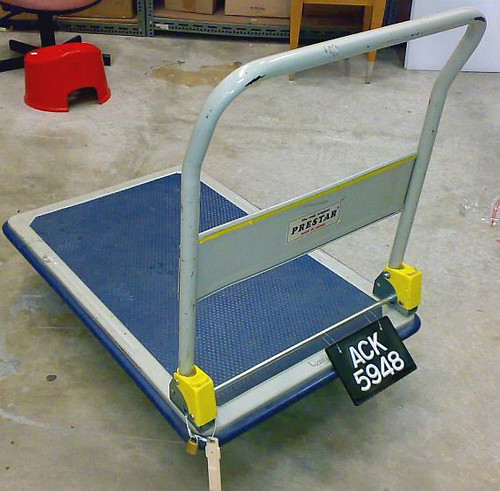
The best way to save your petrol fuel is do not use car, use trolley. Found this picture in TheStar Thumbnail. Haha, quite interesting way of transport.
No more petrol price increase in this year? I heard in August they will increase to RM4?? Is this for sure not increasing? or a lie?
Just like they say will not increase but after one day, announce totally different thing? Will you believe or can u believe no more petrol price increase?? Personally I don’t. Just prepared yourself for the increase I would say. Or maybe they keep their word and it will increase on the 1st day of 2009.
Who can garuntee this would not ever happen again?
PM: No more petrol price increases this year
BY MAZWIN NIK ANIS & SIM LEOI LEOI
PUTRAJAYA: There will be no further increase to the price of fuel in the country this year despite the possibility of the global price of oil reaching US$200 (RM660) per barrel, the Prime Minister said.
This latest decision by the Cabinet came on top of various measures announced on Monday to help the Government cut costs and channel more subsidies to low income earners.
Datuk Seri Abdullah Ahmad Badawi said to stem any more increase, the Government would have to think of alternative ways to finance its spending.
“If that is the decision of the Cabinet, this will remain so despite further jumps to the global price of oil.
“Since the Government announced the new price last week, fuel prices have gone up to US$139 (RM459) per barrel and is still hovering at US$130 (RM429).
“In fact, the price of oil is expected to remain at high levels in the months to come. The high price of oil means that the market price of petrol at the pumps have now reached RM3.45 per litre,” he said, adding that the price should be reviewed to RM3.15 per litre instead of RM2.70 beginning next month.
“However, the Government realises that the rakyat (citizens) are still trying to adapt themselves to higher petrol prices. The Cabinet has thus decided there will be no more increase this year,” he told reporters at his office here on Wednesday.
If the global price of petrol should ever drop, Abdullah said the Government would make the necessary adjustments with the 30 sen discount still being given.
In the June 4 announcement of the new petrol price, Abdullah had said that prices at the petrol pump would be adjusted monthly to reflect global market price.
The Premier also said that in the National Inflation Council meeting on Monday, it had been decided that the over one million civil servants would now be paid their monthly salaries in two instalments, staring in August.
“The first instalment will be paid in the middle of the month while the second will be at the end of the month.
“Any income tax, Employees’ Provident Fund or others will be deducted from the second instalment,” he said.
PUTRAJAYA: Against a backdrop of anger and frustration as the people come to grips with the new high prices for fuel, the cabinet yesterday decided that there will no further price hikes this year to allow the people time to adjust to to the situation.
Prime Minister Datuk Seri Abdullah Ahmad Badawi said the government is aware of the consequences should the price rocket upwards in the world market, but it will maintain its decision and find other means to bear the additional expenses.
On June 4, the government had decided that subsidy for petrol be fixed at 30 sen per litre, and that there would be a monthly review based on world prices.
Because of this formula, petrol price went up 78 sen to RM2.70 per litre, while diesel went up by RM1 to RM2.58.
“However, the price on the world market increased drastically to more than USD130 per barrel on June 8 and is expected to be higher in the coming months,” Abdullah said.
“This resulted in petrol price in the local market increasing to RM3.45 per litre. If the government were to implement the 30 sen subsidy, the price of petrol would have to be raised from RM2.70 to RM3.15 per litre next month.”
Although the 30-sen buffer will not be used for the rest of the year should crude prices rise further, he said it will be used if world prices drop. This would cause the present pump prices to drop.
Abdullah assured that the government is “thinking of all kinds of additional measures because we know the price increase is high and everyone, including the government, is facing difficulties, not only the people”.
Asked whether the government’s revenue will be affected by the decision, he said: “Since the price of petrol has increased, we could hope to get additional revenue from Petronas.”
At the press conference, Abdullah also announced another move to help civil servants better manage their household expenses and cash flow — their salary will be paid in two instalments effective August.
“The first half will be paid in the middle of the month and the rest at the end of the month. Deductions such as for income tax, Employees Provident Fund and others will be done at the end of the month,” he said.
Asked whether he would recommend the private sector do the same, he said: “I see this as a good move to help our workers manage their household cash flow better.”
The fuel price will see an increase of 78 sen by August – a massive jump from RM1.92 per litre currently to RM2.70, Prime Minister Abdullah Ahmad Badawi is expected to announce today.
this is crazy… why? tell me why? just cut on the Singaporean and Thai subsidy will be good enough but not cut on our Malaysian subsidy!
I even got sms from my friend tell me that the price is gonna effective today midnight 5th June? Can you believe that? Past few days some ppl also sms and spread the rumor that petrol price will be increased effective on 1st of June but it’s all rumor and who’s benefiting from it? I would say is the Petrol Station and Telco. Think about it and do not forward until it’s confirmed.
—————————-
Updates! IT’S CONFIRM THAT PETROL PRICE WILL INCREASE TO RM2.70 EFFECTIVE 5/6/2008 5TH JUNE!
It’s confirm and do inform your friends, relatives, family, enemies…
It’s freaking 40% increased this time. How many percent is your last increment? It’s crazy…
What’s our government doing? Aren’t they said August? Suddenly now become tomorrow? Liar? We pay tax and all… now they treat us in this way? What’s happening man? I think I will not go pump petrol instead go get myself a bike and cycle to work and anywhere without worrying of when the government decide to increase the petrol price again!
Everybody, let’s cycle.
——–
Live update from Petrol Station.
It’s jam packed. If you want to go to pump petrol now, make sure you bring along cash$$ do not depend on your credit card. I guess it’s line down for Visa or Master. I was lucky that I have Amex and I can still use my Credit Card if not I do not have enough cash for me to go full tank! Take note, bring enough cash. The credit line will be jam and line down…
Updates again Tactic to pump petrol in last 4 hours from 8.00pm
1) Find a place where there’s few petrol station in the area to avoid jam pack and reduce waiting time.
2) Bring enough cash$$, do not depend on Credit Card as the line is jam and I heard I was down for Visa and Master Card but luckily I have Amex Card.
3) After pump petrol, go back using those road without petrol station.
Fuel hike: 78 sen more to RM2.70 per litre
Jun 4, 08 4:55pm
The government has just announced that petrol price to go up by 78 sen at midnight – a 40.6 percent jump from RM1.92 per litre to RM2.70.
- Effective midnight
- RM625 rebate for vehicles
Harga petrol naik sebanyak 78 sen – satu pertambahan besar dari RM1.92 sekarang kepada RM2.70.
Manakala harga minyak diesel pula naik kepada RM2.50 – naik 92 sen berbanding harga sekarang sebanyak RM1.58 seliter.
Kenaikan sebanyak 41 peratus bagi petrol dan 58.2 peratus bagi diesel akan berkuatkuasa mulai tengah malam ini.
Kenaikan harga itu adalah sebahagian daripada langkah kerajaan untuk mengawal subsidi bagi menampung kenaikan petrol, diesel dan gas, yang dijangka berjumlah RM56 bilion tahun ini.
Kerajaan juga mengumumkan pemberian rebet kepada pengguna kenderaan.
Mengikut skim tersebut tersebut, kenderaan di bawah 2000cc akan menerima RM625 setahun – rebat bagi 800 liter di bawah harga baru.
Pemilik motosikal pula akan diberi rebet RM120. Bayaran akan dibuat melalui wang pos.
Difahamkan rebet teresbut akan dibayar apabila pemilik kenderaan memperbaharui cukai jalan kenderaan mereka.
Kerajaan dijangka menjimatkan RM4 bilion di bawah penstrukturan semula skim subsidi tersebut.
Jika harga petrol dijual mengikut harga penuh pasaran, ia boleh mencecah setinggi hampir RM4 seliter – naik 100 peratus.
Bagaimanapun, kerajaan dijangka menuju ke arah memansuhkan terus pemberian subsidi pada masa depan.
BREAKING NEWS: Petrol will be RM2.70 a litre at midnight tonight
By : Newsdesk
PUTRAJAYA, Wed:
The new price of petrol is RM2.70 per litre beginning midnight tonight, it was announced a moment ago by Domestic Trade and Consumer Affairs Minister Datuk Shahrir Samad. Diesel will go up by RM1 per litre while the price for ULG 92 per litre went up by 74 sen. The 78 sen hike or 40 per cent increase for the ULG 97 petrol is still below the antiticpated RM4 per litre price projected earlier and among the cheapest in Asia.
KUALA LUMPUR: Prime Minister Datuk Seri Abdullah Ahmad Badawi on Wednesday announced the new price for petrol is RM2.70 a litre, effective midnight tonight.
He announced that the price of petrol would be increased by 78sen and diesel by RM1.
The 40% increase in petrol price is part of the new fuel subsidy plan the Prime Minister announced at 5pm Wednesday.
The price of diesel goes up to RM2.58 from RM1.58.
KUALA LUMPUR: A new fuel subsidy scheme to be announced tomorrow will take immediate effect to prevent further speculation.
Prime Minister Datuk Seri Abdullah Ahmad Badawi said the anti-inflation committee would decide today on the various proposals put forward by the Cabinet.
He was speaking to reporters after chairing the national small-and-medium enterprise development council at Bank Negara here yesterday.
Abdullah was asked to confirm an announcement made by Domestic Trade and Consumer Affairs Minister Datuk Shahrir Abdul Samad that a new fuel subsidy scheme would most probably be implemented in August.
Abdullah said: “He said ‘might be’. As far as the subsidy management scheme is concerned, the final decision will be made on Wednesday.
“It was to be decided last Friday but it so happened that many of the ministers (involved) were attending conferences overseas. We wanted all to be present to make the decision.”
Asked whether the announcement would take effect immediately, he said: “We want it to be effective immediately. If not, there will be a lot of speculation.”
He, however, did not disclose what the new subsidy scheme would involve.
Earlier at Parliament, Shahrir said any change in the subsidy scheme might result in a rise in petrol and diesel prices.
He said the scheme might be changed in August as stated earlier by Second Finance Minister Tan Sri Nor Mohamed Yakcop.
“It will happen. Petrol price will increase,” he said at the lobby of Dewan Negara yesterday.
However, he said Malaysians would still enjoy subsidies, but it would be given based on need.
On another matter, Abdullah said the Government would set up a special committee to recommend measures to reduce the impact of rising costs and oil prices on small-and-medium enterprises (SMEs).
He said measures to be considered included tax incentives to encourage SMEs to upgrade their machinery and equipment as well as adopt new technology.
Abdullah said the measures were vital to ensure that SMEs were not forced to shut down due to rising oil prices.
He said that more than 286,000 SMEs received assistance through the implementation of 189 key development programmes involving RM4.9bil.
Asked whether the RM1bil special allocation for rural development in Sabah was due to pressure by Sabah Barisan Nasional leaders, he said: “It’s for infrastructure development in rural areas in Sabah. It’s from the Federal Government. It’s part of the consideration we are making at the moment.”
Here I'll share my knowledge, discovery and experience related to latest news, gadgets and happening stuffs. Most articles on this site are related to IT, short reviews, tips and latest offers and many more. More