Petrol, diesel prices: Another 10 sen cut

Monday, December 15th, 2008 | 199 Views

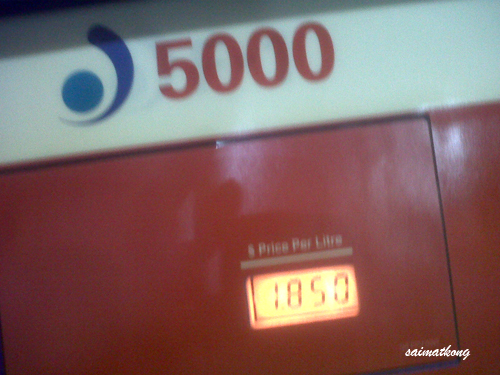
Petrol Reduce to RM1.80

Another 10 sen cut in Petrol Price!

View previous post on petrol / fuel price

Petrol, Diesel Prices Down 10 Sen Tomorrow, 7th Reduction Since August

KUALA LUMPUR, Dec 15 (Bernama) — Petrol and diesel prices have been reduced by 10 sen a litre from Tuesday.

In announcing the reduction today, Prime Minister Datuk Seri Abdullah Ahmad Badawi said the RON97 petrol will be sold at RM1.80 a litre from RM1.90 and RON92 petrol at RM1.70 from RM1.80.

Diesel will be sold at RM1.70 a litre from RM1.80, he said in a statement today.

This is the seventh time the government has lowered fuel prices since August. The last revision was on Dec 3.

The fuel price cut was in tandem with the dwindling crude oil price in the world market.

Also effective tomorrow, the price of subsidised petrol and diesel for fishermen has been slashed by 13 sen a litre to RM1.30 from RM1.43, he added.

BERNAMA

Petrol, diesel prices: Another 10 sen cut

Petrol and diesel prices will be reduced by another 10 sen per litre effective tomorrow, announced the government today.
- Petrol now RM1.80 per litre
- Seventh reduction since Aug

Source : Malaysiakini

汽油柴油價16日再降10仙

汽油及柴油價格從週二起(12月16日)每公升再調低10仙。
汽油及柴油價格從週二起(12月16日)每公升再調低10仙。(圖:星洲日報)

(吉隆坡)政府於今日(週一,12月15日)宣佈汽油及柴油價格從週二起(16日)每公升再調低10仙,即無鉛97汽油從1令吉90仙降至1令吉80仙,而柴油則從1令吉80仙降至1令吉70仙。

首相拿督斯里阿都拉在文告中指出,無鉛汽油92則從每公升1令吉80仙降至1令吉70仙。

調整油價後,意味著已比今年6月5日起76仙前的1令吉92仙還要低12仙。此次的調整也是今年8月23日以來的第7次油價下調。

Source : SinChew-I

If you liked this post, buy me a beer. (Suggested: $3 a beer or $7.5 for a pitcher)

Malaysia considers dumping petrol subsidy scheme and we have no more petrol subsidy?!?

Thursday, November 20th, 2008 | 249 Views

What??! We are not getting subsidy from our Malaysia Government anymore and we are the one who subsidising the Malaysia Government? In actual fact we should be paying RM1.62 or RM1.70 per liter? What say you and what’s your reaction?

How could it be?

Malaysia considers dumping petrol subsidy scheme

Malaysia is not currently subsiding petrol and may dump its subsidy scheme altogether, despite major protests earlier this year over spiralling pump prices, a minister said Tuesday.

The government on Tuesday cut pump prices by seven percent to 2.00 ringgit (0.56 dollars) per litre as global crude prices continued to ease. The price of diesel was also reduced by 15 sen to 1.90 ringgit per litre.

“We have stopped subsidising petrol from the time when the pump prices were cut to 2.00 ringgit per litre,” Domestic Trade and Consumer Affairs Minister Shahrir Samad told AFP.

He said that at current prices, the government is making about 30 sen per litre.

“At about 60 dollars per barrel we are already making money,” he said.

Shahrir said the government was still handing out direct subsidies in the form of cash rebates for motorists of 625 ringgit per year and that diesel and liquefied petroleum gas (LPG) were still being subsidised.

“The rebate system is still being enforced… but it will runs its course until March next year before we either stop it or implement a new system,” he said.

Tuesday’s cut was the fifth the government has announced since a 41 percent hike in June as the price of crude soared, sparking angry street protests and calls for Prime Minister Abdullah Ahmad Badawi to resign.

Shahrir said the government will decide by the end of the month if subsidies will be reinstated if crude oil prices go up again. It will consider setting a floor price of 1.92 ringgit per litre.

“I would be happy to have a floor price of 1.92 ringgit. This would allow the government to earn some revenue and it is also easier to manage the price,” he said.

“It is also a better option because we can use the savings for development or to reduce the deficit.”

The government earlier this month announced a 7.0 billion ringgit (2.0 billion dollar) stimulus programme — reaped from savings on reduced oil subsidies — to boost the economy amid the global slowdown.

But the additional spending saw the government widen its budget deficit forecast for 2009 to 4.8 percent, from 3.6 percent predicted in August.

Source : MSN

‘Reveal fuel price mechanism’

Hafiz Yatim | Nov 19, 08 2:17pm
The revelation by Domestic Trade and Consumer Affairs Minister Shahrir Abdul Samad yesterday that the government has stopped subsidising fuel since early this month raises more questions than answers.
- Consumers subsidising the government
- Engage stakeholders before policy shift

Source : MalaysiaKini

Consumers already paying more than full cost
Nov 19, 08 11:33pm
The government may dump its petrol subsidy scheme altogether as consumers are already paying more than the full cost at the pumps at current price level.
- Consumers pay gov’t 30 sen per litre
- Lim: Actual price should be RM1.62

If you liked this post, buy me a beer. (Suggested: $3 a beer or $7.5 for a pitcher)

Petrol prices cut by 15 sen per litre

Friday, October 31st, 2008 | 286 Views

It’s confirmed that we will be having cheaper fuel price. This proof that what I’ve been waiting for is not wasted =)
Another cut is expected on Nov 15… woot!!

PUTRAJAYA: Petrol and diesel prices will go down 15 sen a litre from 12.01am on Saturday - the fourth reduction since August.

The new price of a litre of RON97 will be RM2.15 from RM2.30; RON92 will be RM2.05 from RM2.20; and diesel will be RM2.05 from RM2.20.

The prices will be reduced so that the people could enjoy the benefit of the recent drastic drop in global fuel prices, said Prime Minister Datuk Abdullah Ahmad Badawi in a statement on Friday.

The Star reported on Friday that petrol price will go down by 15sen and that petrol dealers expect another round of price cuts on Nov 15.

Domestic Trade and Consumer Affairs Minister Datuk Shahrir Abdul Samad said that if the world crude oil price continued to drop at the present rate, local pump prices would likely revert to the pre-June price of RM1.92 per litre.

Shahrir, who said the average world crude oil price for October was US$76.40 (RM267.40) per barrel, said the average for November might go below US$70.

“So (if this happens) the price of petrol at the retail level will probably go back to RM1.92 per litre,” he said.

As a cap has been placed on a price of RM1.92 per litre, he said that if the world crude oil price goes down even lower than that, the Government could end its fuel subsidy and use the money for other purposes.

For this year up to September, the Government spent RM16.8bil on fuel subsidy and RM2.5bil on rebates for motorists and motorcyclists.

“That means there is a likelihood that we will spend RM19bil to RM20bil on fuel subsidy for the whole year,” Shahrir said.

Shahrir hoped petrol station owners would accept the price reduction and accept any loss as part of business.

He pointed out that the Government had always been fair to the station owners, including helping them reduce operating costs by reverting to self-service, cutting on the number of staff, not forcing them to open for 24 hours as well as increasing their margin from 9.5 sen to 12 sen per litre in June.

Source : TheStar

If you liked this post, buy me a beer. (Suggested: $3 a beer or $7.5 for a pitcher)

Govt expected to reduce petrol price by 15 sen a litre Saturday

Friday, October 31st, 2008 | 269 Views

Yes PETROL PRICE GONNA REDUCE AGAIN, I have been waiting for this and my fuel tank was empty this few days and just pump 30 bucks to keep my car moving… ahah kiasuness…

PETALING JAYA: Petrol prices are expected to be cut by 15 sen a litre at 12.01am tomorrow – the fourth reduction since August.

This means the RON97 will cost RM2.15 a litre, down from RM2.30, and the price of RON92 is also expected to go down.

Petrol Dealers Association of Malaysia (PDAM) president Abdul Wahid Bidin said they expected the new prices to take effect early tomorrow although they have not received a directive from the Finance Ministry.

A dealer who declined to be named said Domestic Trade and Consumer Affairs Minister Datuk Shahrir Abdul Samad had met with PDAM representatives on Wednesday.

He said Shahrir gave them notice that prices were going down.

“This is good because it has given us the three days we need to figure out how much stock we should keep to avoid big losses,” he said.

It is also understood that another price change is expected on Nov 15.

When asked at a function here yesterday, Shahrir refused to confirm or deny that prices would be reduced tomorrow.

“A reduction is imminent of course. We cannot deny consumers the opportunity that has arisen from lower global oil prices,” he said.

Shahrir, however, said that any directive would come from the Treasury and that any agreement on reducing prices would be discussed by the Prime Minister, Deputy Prime Minister, Second Finance Minister and himself.

“So it is difficult for all of us to meet at one time. There is, however, a Cabinet meeting (today), so it will probably be discussed then.”

Shahrir said that the Government would also be moving to make price changes every fortnight.

“This would be an ideal situation. If the price is changed once a week, it will be too short a time for any effects to be felt.”

He said petrol dealers had to realise that they were in a business and that other businesses also suffered when prices changed.

Source : TheStar

If you liked this post, buy me a beer. (Suggested: $3 a beer or $7.5 for a pitcher)

Cabinet mulling over lowering fuel prices! Lower Fuel Price? Reduce Fuel Price? Petrol Price may drop?

Thursday, July 31st, 2008 | 386 Views

Cabinet mulling over lowering fuel prices

PUTRAJAYA: Malaysians may be paying less for fuel soon as the Cabinet is mulling over the possibility of lowering the present prices.

Several Cabinet Ministers said the matter was discussed during their weekly meeting Wednesday but declined to elaborate, saying that Prime Minister Datuk Seri Abdullah Ahmad Badawi was expected to make an announcement soon.

Higher Education Minister Datuk Seri Mohd Khaled Nordin said the possibility of consumers paying lesser for fuel was raised and that the mechanics were still being worked out.

Information Minister Datuk Shabery Cheek also admitted that the Cabinet was studying the matter.

“Let the Prime Minister make the announcement,” he said yesterday.

Domestic Trade and Consumer Affairs Minister Datuk Shahrir Samad , however, declined to comment on the subject, saying that it would be best to wait for the PM.

The government, had on June 4, raised the prices of petrol and diesel, on grounds that that it could no longer continue to subsidise fuel, but give a 30 sen per litre discount from market prices.

Currently, Malaysians are paying RM2.70 per litre at the pump while diesel is priced at RM2.58 per litre.

Source : TheStar

Updates

Fuel prices may drop soon, say ministers

PUTRAJAYA: Malaysians may pay less for fuel soon, as the Cabinet is mulling over the possibility of lowering the pump prices.

Several Cabinet Ministers disclosed that the matter was studied during their weekly meeting yesterday but declined to elaborate, saying that Prime Minister Datuk Seri Abdullah Ahmad Badawi was expected to make an announcement soon.

Higher Education Minister Datuk Seri Mohd Khaled Nordin said the possibility of consumers paying less for fuel was discussed and that the mechanics were being worked out.

Information Minister Datuk Shabery Cheek said the matter was studied by the Cabinet, but declined to elaborate.

Domestic Trade and Consumer Affairs Minister Datuk Shahrir Samad, when contacted, declined comment, saying that it would be best to wait for Abdullah to make an announcement at an appropriate time.

On June 4, the Government raised petrol and diesel prices, stating that it could no longer continue to subsidise fuel prices at the then rate. However, it would continue to provide a 30 sen per litre discount on the market price.

Currently, motorists pay RM2.70 a litre for petrol and RM2.58 a litre for diesel at the pump.

Shahrir was quoted by Bloomberg.com on Tuesday as saying that the Government might reduce fuel prices if crude oil prices stay at US$125 (RM408) per barrel for at least three weeks.

Shahrir said that it that was the case then a reduction in prices could come within the year to enable the Government to keep its pledge of maintaining a 30 sen per litre subsidy.

“Why not, it would be good news, right?” he said during the interview.

Source : TheStar

There’s news to reduce fuel prices?! Remember last two week Pak Lah supposed to announce steps to ease fuel price rise burden? But after the news, there’s no one talking about it or no updates at all? What happened? I was waiting for the steps to ease fuel price but nothing happened. Now news review that fuel prices will be lower down? How much? How soon? Is it 100% real?

I will start dreaming from today on wards for lower fuel price and better economy =)

Wait for the announcement! Hopefully yes but what about those ppl that claim their fuel subsidy of RM625 from pos office? Too bad, my road tax due at March, so I still haven’t claim back my subsidy!

If it’s really true that our fuel price will be lower down, then will other goods, food, transport all reduce their price too? I don’t think so. Roti Canai, Bread, Rice, all increased. They will happily earn more!

If you liked this post, buy me a beer. (Suggested: $3 a beer or $7.5 for a pitcher)

‘Fuel price hike a blessing’

Tuesday, June 24th, 2008 | 544 Views

‘Fuel price hike a blessing’

Jun 16, 08 10:46am

vox populi big thumbnail‘It will put both businessmen and politicians in their place. For too long, both of them have been shortchanging the Malaysian public.’

On 2,000 play ‘cat and mouse’ with cops

Joe Fernandez: All this is a blessing in disguise. Look for the silver lining in the cloud and count your blessings. Be thankful and grateful and you will have even more reasons to be thankful and grateful for.

I am glad the runaway fuel prices will put Malaysian businessmen, noted crooks and criminals, in their place. Traditionally, they shortchange their workers, the consumers, the government and investors. Now, they are forced to absorb the rising fuel prices and make do with smaller profit margins. If they increase prices for their goods and services, the market will eliminate them.

The runaway fuel prices will also put the politicians in their place. In the past, they were in cahoots with their businessmen friends to create unnecessary government projects to steal indirectly from the treasury.

Dr S Vijayaratnam: In view of the increased cost of fuel, particularly diesel, the government is urged to give priority to the commercial transport sector. The uninterrupted operation of haulage of goods, especially food items, is essential to the well-being of the general public.

We don’t want to see a situation where, due to a slow-down or cessation of this lifeline, wet markets, supermarkets and hypermarkets are devoid of meat, vegetables and grain on their shelves. Such a scenario is frightening, and can lead to social problems and unrest. We can see it building up in Spain and Thailand right now.

It was pointed out in a recent newspaper article that if the food supply chain is hampered for just three or four days, and retail outlets are empty, there is the danger of people becoming desperate, and no telling what they could resort to.

We appreciate that lorry transporters recognise their national responsibility, and are continuing with their operations. However, it is vital that compensation or incentives in some form is given to them, so that daily groceries and edibles from farms, abattoirs, ports and warehouses, most of which are perishable, continue to be delivered.

Among other measures, road tax reduction, exemption of import duties on spare parts and tyres and raising the fleet-card quota for subsidised diesel could be considered.

If we are talking about food security, transportation an essential component. The process cannot be compromised due to high fuel costs. (the writer is vice-president, Gerakan).

JD Lovrenciear: In the wake of the pandemonium resulting from the horrendous fuel price hike, the government recently announced several cost cutting options involving ministers.

Unfortunately the government’s seemingly good intentions has only drawn much flak from the public. Perhaps the government should consider some common sense back-to-basics strategies to gain brownie points and also to address the fuel-price threats effectively.

As any crisis also offers opportunities, the government should think outside the box and table more pragmatic solutions. One such creative solution would be bringing back the humble trishaw to our streets.

Numerous streets in the towns and cities could be turned into trishaw-thoroughfares without much complication.

Bringing the trishaws back also serves as a double bonus. Not only will the demand for fuel be reduced and the street air made more breathable, it also offers many Malaysians an opportunity to earn or save that extra ringgit to help combat the financial squeeze.

Further, if properly nurtured - minus the greedy grabbing hands of politician-businessmen, many of our young and enterprising youths could be well on their way to earning a decent income let alone being more productive.

Surely the rakyat will find the trishaw rides convenient, cost-effective and above all, save the nation’s fuel burning arising from unending traffic jams in main cities and towns.

Hopefully if the government does not take this idea through, the opposition government in the several states could take up the suggestion and show our ruling government the ‘way forward’.

Albert Heng: I don’t believe that ministers ever pay for any entertainment so why should they get an allowance for it at all? In all cases, I believe certain people would rush to pay for any entertainment for a minister, or perhaps be cowed into paying!

Mooshie Mooshie: Will Petronas show us its accounts? No way, not in a million years. It is also known as the ATM (automated teller machine) of the Malaysian government namely Umno’s giant cash kitty.

It will get a lot of people in trouble if Petronas has to show its accounts to the public or parliament. Maybe when the Pakatan government comes to power, then it can be done.

So fellow Malaysians you know what to do lah. And to Pakatan you also keep your promise ya?

Joe: The foreigners are merrily chirping away again, ‘Cheep! Cheep!’ And why not? At RM 2.70, they’re paying about half of what they pay at home!

Why raise the petrol price for locals so heftily and allow the foreigners to enjoy the same ‘cheep’ price? Simple arithmetic will tell you to raise the price for foreigners to a level high enough to offset whatever claimed losses Petronas is suffering but still lower than foreign prices - RM4.50 for example. They will still pay as they still save.

Arthur Chan: Many Malaysians are not aware that the state of Kelantan has not been explored for oil and gas. The BN government didn’t spend any money on this state because it is under PAS rule. The sea area off Kelantan state is just as large as Terenggnau’s.

John Johnson: I am a bit surprised that the royalty are keeping mum over the dissatisfaction of the majority of the rakyat. There are important issues that are causing pain and suffering to the rakyat but not one of them has come out openly to say something to let the people know that they are supportive of the rakyat.

Richard Kamalanathan: The oil price has been rising remarkably in the last six months beyond our meagre expectations and it is not going to recede as much as we would wish it to be. It is has increased our burden of movement via private and public transportation;

The government may not be able to interfere as much as it would wish to. The international and global economy has to confront these rises and adapt its future course in accordance with numerous rises in other sources of energy especially electricity.

The price of steam coal has risen by leaps and bounds now too. The cost of electricity has yet to rise. I do not wish to appear fair to the government but I only wish that most of us would approach our own political parties to which we belong to come out with a clear policy as to how we can overcome the oil prices and help the people who are in dire need of survival.

The survival syndrome in Malaysia is already around the corner and political parties like the DAP, PKR and PAS must explain how they will overcome these increases and promise the people who have elected them a better alternative.

Ikunosan: The government should retract all APs issued, and instead sell the APs to anyone that wants to import a vehicle. This way, the estimated 7000 - 10,000 APs issued a year can generate, at RM40K average price of an AP, an estimated: RM 40,000 x 10,000 AP = RM400,000,000!

This is all about BN mis-management, they giving out APs to help only the few.

Hafiz: Personally, I have no qualms on the right of the people to voice their dissatisfaction on the increase in fuel prices. My view is that such protests should be channeled through proper means.

I personally feel that the organisers should think twice about organising another ‘mega’ protest because it can lead to a waste of resources especially if such an action is planned to be repeated.

Protests on the street can lead to road closures, traffic congestion and a sudden influx of people coming into the city - aren’t these leading to a waste in fuel for the ordinary Joe who is stuck in his car trying to get home but ‘forced’ to join in the rally of people?

Can we think of other means of protests instead of street rallies, please?

On A sustainable public transport system - possible?

Maniam Sankar: Okay, so improvements to public transport will only feature in Budget 2009 says the finance minister. When the last price increase for petrol was announced , there was a promise to improve public transport including adding more coaches to train.

Even a date, October 2008, was mentioned for the additional coaches. And now the minister only wants to include it in the 2009 budget which means we’ll be lucky to see the expansion in early 2009, if at all. In the meantime, dear Malaysians, do be resigned to the ‘sardine tin’ rides

Allow me to suggest immediate improvements to the bus service so that they follow the example of buses in Singapore and most Australian cities. During peak hours (6.30aam to 9am and 4.30pm to 7pm say ) send express buses direct to the residential areas.

Do not let them go from one taman to the next before going to the city or vice versa as that lengthens the commute time. For example, instead of sending buses at 10 minute intervals and going through two or three taman, send one direct bus every 20 minutes from each taman.

After peak hours, stop buses, except those from neighbouring suburbs from coming into the city but use them to ferry commuters to the nearest train station and shopping areas. By this time, the crowd will be latecomers and moms will be doing shopping so this will fill up trains and buses which will be running empty by now.

This system works in the cities aforementioned. Right now, not many bus routes pass the nearest shopping centres or train stations as they are all headed to KL only. There is hardly any intra- taman or neighbourhood bus services.

It is presently easier to get from any suburb to KL than from, say , PJ to PJ or Subang to Suban. Please do the easy fixes first. The grand solution can come later.

On The BN’s or PM’s fatal remedy?

John Lee: I think Dr Dzulkefly has made a mistake in his economic analysis of subsidies. As a general rule, subsidies and indirect taxes are part of the field of micro-economics. A simple microeconomic analysis would actually suggest that subsidies are harmful because they isolate people from the costs of their actions - there is a ‘deadweight loss’, to use some economics jargon.

Of course, the situation is more complicated than that, but ultimately I don’t think subsidies are the best way to aid the poor.

A proper macroeconomic analysis of the situation would treat the subsidies as government spending. As a rule, government spending does boost the economy. Dzulkefly is correct to say that this is ‘beneficial for the rakyat.

However, not all spending is alike. A subsidy primarily benefits people who buy a lot of petrol. Those who buy gas guzzlers and drive over the speed limit benefit more from the subsidies than those who take public transport or drive compact cars. This government injection of money into the economy primarily benefits the rich.

A more appropriate form of spending would be to give people the money directly, perhaps in accordance with their income (so a middle-class family gets a smaller or even no rebate, while the hardcore poor get substantially more).

This would be more efficient than an un-targeted subsidy, and would act as a subsidy for whatever the families decide to spend their money on, rather than just a subsidy for petrol. If I decide I would rather buy a book than fill up my tank, I still benefit.

Unfortunately, the government persists in ill-advised fiscal policies. Petronas’ profits should not be going to prop up foundering cronies’ enterprises or subsidising ministers’ vacations. They should be rebated directly to the Malaysian people, or invested for long-term benefit of the country.

The government’s reduction of the fuel subsidies is a good start, but as long as they spend the new revenues imprudently, our frustration at the government will continue to be justified.

Stephen Chew: In the article, the writer touts the ability of net oil-exporting countries like Venezuela and Iran, to provide highly subsidised fuel for their citizens, implying that surely Malaysia can and should do the same.

Beware the paradise of cheap petrol, as the real picture is not as rosy as depicted. The truth is that the governments of Venezuela and Iran have been trying for years to remove these economically distorting subsidies, but are cowed by vociferous citizens who treat cheap oil as a birthright.

Ever since 1989, when thousands of Venezuelans died in fuel hike protests, reducing fuel subsidies have become politically impossible even for the popular President Chavez (he calls the subsidy ‘disgusting’).

Despite ever rising oil prices, the Venezuelan economy does not benefit as huge amounts of money are drained from the national oil company to pay for subsidies - money that could instead be used for social welfare and development programs. Sounds familiar?

You might think it would be easy to fill up your petrol tank in a country that exports more oil than almost any other country in the world. But as of May 21, 2007, Iranians are no longer free to buy as much subsidised petrol as they want due to a rationing system introduced by the government in Tehran - resulting in riots which destroyed many petrol stations.

Until then, the government of Iran had subsidised gasoline to keep prices down, but the programme has proven exorbitantly expensive in a period when the Iranian economy is struggling.

Can the Iranians really afford to provide cheap petrol for its citizens as the writer asserts?

What is clear is that oil prices in Venezuela and Iran have been kept low despite its devastating economic consequences! Do we really want Malaysia to follow in their footsteps?

On Electricity: C’mon, no one uses less than 200 kW

Soo Ching Pin: Concerned Netizen mentioned that an air-conditioner is in use in the house he/she was talking about. I think that is the culprit for power consumption. My younger brothers have installed air-conditioning in the house that they share with my mother.

Since they did that, their monthly electricity consumption has gone over 200 kW, just as in Concerned Netizen’s house.

On the other hand, I do not have air-conditioning in the rented house where I live. I live alone and my monthly electricity consumption has averaged less than 100 kW so far. Granted, I am not at home at least 10 hours a day as I work outside the home, except for my off days.

But when I am at home, I will usually have at least one light on. I also have the standard household appliances like a refrigerator, TV set, DVD player, a rice cooker, a kettle, etc. Of course, the refrigerator is always on unless I shut it down for defrosting but that will only take an hour or so every two weeks or more.

So I conclude that when the government says that more than half the households in Malaysia use less than 200 kW per month, those are the households that do not have air-conditioning. Can we have some statistics from air-conditioning suppliers as to what percentage of Malaysian households have installed air-conditioning?

Then we can see whether their figures are consistent with what we would expect in view of the government’s figures on the proportion of Malaysian households using less than 200 kW per month.

source from Malaysiakini.com

If you liked this post, buy me a beer. (Suggested: $3 a beer or $7.5 for a pitcher)

PM: No more petrol price increases this year?

Thursday, June 12th, 2008 | 572 Views

No more petrol price increase in this year? I heard in August they will increase to RM4?? Is this for sure not increasing? or a lie?

Just like they say will not increase but after one day, announce totally different thing? Will you believe or can u believe no more petrol price increase?? Personally I don’t. Just prepared yourself for the increase I would say. Or maybe they keep their word and it will increase on the 1st day of 2009.

Price fuel increased

Who can garuntee this would not ever happen again?

PM: No more petrol price increases this year

BY MAZWIN NIK ANIS & SIM LEOI LEOI

PUTRAJAYA: There will be no further increase to the price of fuel in the country this year despite the possibility of the global price of oil reaching US$200 (RM660) per barrel, the Prime Minister said.

This latest decision by the Cabinet came on top of various measures announced on Monday to help the Government cut costs and channel more subsidies to low income earners.

Datuk Seri Abdullah Ahmad Badawi said to stem any more increase, the Government would have to think of alternative ways to finance its spending.

“If that is the decision of the Cabinet, this will remain so despite further jumps to the global price of oil.

“Since the Government announced the new price last week, fuel prices have gone up to US$139 (RM459) per barrel and is still hovering at US$130 (RM429).

“In fact, the price of oil is expected to remain at high levels in the months to come. The high price of oil means that the market price of petrol at the pumps have now reached RM3.45 per litre,” he said, adding that the price should be reviewed to RM3.15 per litre instead of RM2.70 beginning next month.

“However, the Government realises that the rakyat (citizens) are still trying to adapt themselves to higher petrol prices. The Cabinet has thus decided there will be no more increase this year,” he told reporters at his office here on Wednesday.

If the global price of petrol should ever drop, Abdullah said the Government would make the necessary adjustments with the 30 sen discount still being given.

In the June 4 announcement of the new petrol price, Abdullah had said that prices at the petrol pump would be adjusted monthly to reflect global market price.

The Premier also said that in the National Inflation Council meeting on Monday, it had been decided that the over one million civil servants would now be paid their monthly salaries in two instalments, staring in August.

“The first instalment will be paid in the middle of the month while the second will be at the end of the month.

“Any income tax, Employees’ Provident Fund or others will be deducted from the second instalment,” he said.

source

PM: No more fuel price hikes this year

Husna Yusop

newsdesk@thesundaily.com

PUTRAJAYA: Against a backdrop of anger and frustration as the people come to grips with the new high prices for fuel, the cabinet yesterday decided that there will no further price hikes this year to allow the people time to adjust to to the situation.

Prime Minister Datuk Seri Abdullah Ahmad Badawi said the government is aware of the consequences should the price rocket upwards in the world market, but it will maintain its decision and find other means to bear the additional expenses.

On June 4, the government had decided that subsidy for petrol be fixed at 30 sen per litre, and that there would be a monthly review based on world prices.

Because of this formula, petrol price went up 78 sen to RM2.70 per litre, while diesel went up by RM1 to RM2.58.

“However, the price on the world market increased drastically to more than USD130 per barrel on June 8 and is expected to be higher in the coming months,” Abdullah said.

“This resulted in petrol price in the local market increasing to RM3.45 per litre. If the government were to implement the 30 sen subsidy, the price of petrol would have to be raised from RM2.70 to RM3.15 per litre next month.”

Although the 30-sen buffer will not be used for the rest of the year should crude prices rise further, he said it will be used if world prices drop. This would cause the present pump prices to drop.

Abdullah assured that the government is “thinking of all kinds of additional measures because we know the price increase is high and everyone, including the government, is facing difficulties, not only the people”.

Asked whether the government’s revenue will be affected by the decision, he said: “Since the price of petrol has increased, we could hope to get additional revenue from Petronas.”

At the press conference, Abdullah also announced another move to help civil servants better manage their household expenses and cash flow — their salary will be paid in two instalments effective August.

“The first half will be paid in the middle of the month and the rest at the end of the month. Deductions such as for income tax, Employees Provident Fund and others will be done at the end of the month,” he said.

Asked whether he would recommend the private sector do the same, he said: “I see this as a good move to help our workers manage their household cash flow better.”

source

If you liked this post, buy me a beer. (Suggested: $3 a beer or $7.5 for a pitcher)

About Me

Here I'll share my knowledge, discovery and experience related to latest news, gadgets and happening stuffs. Most articles on this site are related to IT, short reviews, tips and latest offers and many more. More

Want to subscribe?

 Subscribe in a reader Or, subscribe via email:
Enter your email address:  

Make Money

PerformancingAds
Advertise Here
Google